
The manufacturing and application of furniture-grade plywood
The Manufacturing and Application of Furniture-Grade Plywood
Plywood is an engineered wood panel product that is a fundamental material in the furniture industry. Its unique cross-laminated structure provides exceptional strength, stability, and versatility, making it a preferred choice for a vast range of furniture applications, from residential pieces to commercial fixtures.
I. Manufacturing Process of Furniture-Grade Plywood
The production of high-quality plywood for furniture involves several precise steps to ensure a superior surface finish and structural integrity.
1. Raw Material Selection:
The process begins with the selection of logs, typically from hardwood species like oak, maple, birch, cherry, or walnut, or softwoods like pine. For furniture, the visual quality of the veneer is paramount.
2. Peeling the Veneer:
The logs are debarked and then softened in hot water baths (conditioning). They are then mounted on a lathe and rotated against a large, sharp blade. This peels a continuous sheet of veneer off the log, much like unrolling a paper roll. The thickness of this veneer is critically controlled.
3. Drying and Clipping:
The freshly cut green veneer has a high moisture content. It is passed through large dryers to reduce its moisture content to an optimal level (typically 6-10%). After drying, the sheets are clipped into manageable sizes and graded based on quality (e.g., clarity, knot size, color consistency).
4. Layup and Gluing:
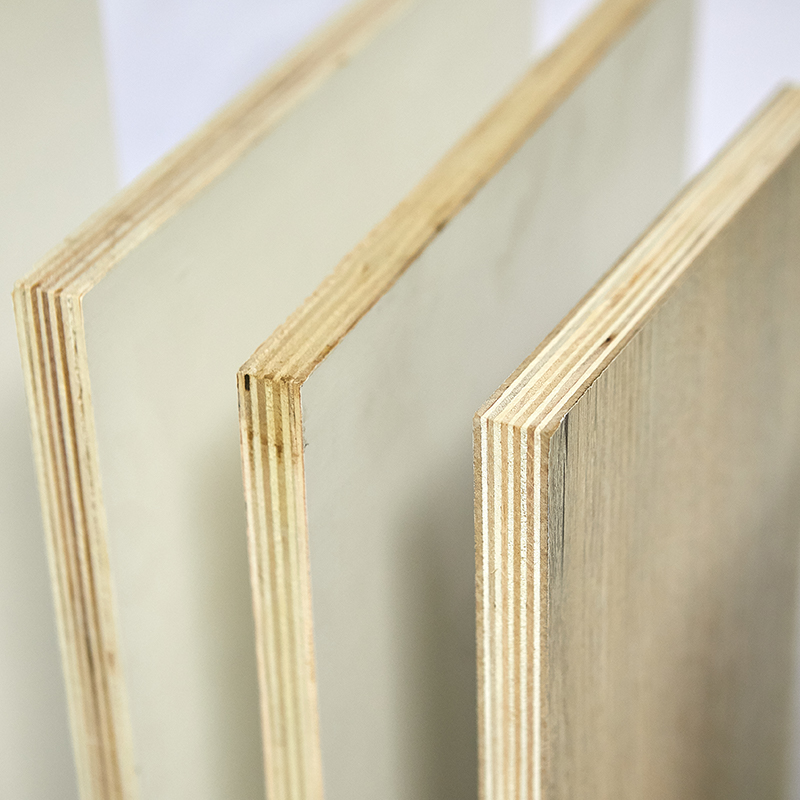
The core of plywood's strength is its cross-grain construction. An odd number of layers (plies) are assembled. The grain direction of each adjacent layer is perpendicular to the one below it. This counteracts the wood's natural tendency to expand and contract with humidity changes, preventing warping and twisting.
A thermosetting adhesive, most commonly Urea-Formaldehyde (UF) for interior use or Phenol-Formaldehyde (PF) for moisture resistance, is applied between each layer.
5. Hot Pressing:
The stacked layers (called a "layup") are placed into a multi-opening hot press. The press applies intense heat and pressure (e.g., 300°F/150°C and 150-200 psi) for a set time. This cures the adhesive, bonding all the layers permanently into a solid, rigid panel.
6. Finishing:
After pressing, the panels are trimmed to their final dimensions, sanded to a perfectly smooth surface on both faces, and graded again. For furniture, a fine, defect-free sanding (e.g., to 180-220 grit) is essential to prepare the surface for finishing.
II. Key Properties for Furniture Applications
- •
Dimensional Stability: The cross-laminated structure makes plywood highly resistant to warping, shrinking, and swelling, ensuring furniture remains straight and true over time.
- •
High Strength-to-Weight Ratio: It is remarkably strong along both its length and width, making it ideal for structural elements like shelves, table tops, and cabinet frames.
- •
Surface Quality: Furniture-grade plywood is available with high-quality "face veneers" that are free of defects and have attractive grain patterns, ready for staining or painting.
- •
Large Sheet Sizes: Available in large formats (e.g., 4' x 8'), it is efficient for manufacturing and reduces the need for joining smaller boards.
- •
Workability: It can be easily cut, drilled, machined, and shaped with standard woodworking tools. However, its layered edges often require banding for a finished look.
III. Applications in Furniture Manufacturing
Plywood is incredibly versatile and is used in almost every category of furniture.
- •
Casegoods & Cabinetry: The primary use. It is the standard material for kitchen and bathroom cabinets, bookcases, wardrobes, and dressers. It is used for sides, tops, bottoms, shelves, and drawer fronts (when covered with a decorative veneer).
- •
Tables & Desks: Used for the entire structural body of tables and as the core for tabletops that are later veneered or laminated. Its stability prevents table tops from sagging.
- •
Seating: Bent plywood is a classic technique for creating the curved shapes of chairs, from iconic mid-century modern designs to modern commercial seating. It is also used for the frames of upholstered furniture.
- •
Built-in Furniture & Shelving: Its strength and availability in large sheets make it ideal for custom built-in units, wall shelving systems, and office partitions.
- •
Decorative Panels & Doors: Used for interior doors and decorative wall panels where a large, stable surface with a fine wood veneer is required.
IV. Types of Furniture-Gly Plywood
- •
Hardwood Plywood: Features face and back veneers of species like oak, maple, or birch. prized for its aesthetic appeal and finished with a clear coat or stain.
- •
Softwood Plywood: Often made from pine or fir. Used for structural parts that will be painted or hidden, or in rustic furniture styles.
- •
Veneer Core: The traditional and most common type, with all layers made of wood veneer. Offers good screw-holding ability and is easy to work with.
- •
MDF Core / Particleboard Core: Has a core of Medium-Density Fiberboard (MDF) or particleboard with wood veneer faces. Provides an incredibly smooth, flat surface that is resistant to telegraphing (where the core's texture shows through the veneer) but can be heavier and has poorer screw-holding strength at the edges.
In conclusion, plywood is an indispensable material in furniture making. Its engineered properties solve many of the inherent weaknesses of solid wood, offering manufacturers and designers a reliable, strong, and beautiful substrate for creating durable and attractive furniture.
Wooden board applications
The comparison of particle board and MDF
